Studying in the Netherlands
Why Study in the Netherlands?
The following factors stand out when choosing Dutch universities for undergraduate education.
- High quality of education offered by universities that rank highly in global rankings
- The opportunity to study in student-friendly Dutch cities
- Widespread use of English throughout the country - availability of English-language programs, albeit limited. The Dutch being an English-speaking society
- Proximity to other educational and cultural hubs in Europe—the UK, Germany, Belgium, France
- Proximity to Turkey, relative ease of transportation
- Relatively low education costs compared to the UK and the US
- The advantages of small class sizes and a culture of group work
Studying in the Netherlands – Some Disadvantages
- Limited options for international students in terms of the number of schools and programs, especially when compared to the US and the UK (there are 14 research universities and 41 applied science schools)
- Accommodation issues - There are very few affordable dormitories for students, especially in cities such as Amsterdam, Rotterdam, and Leiden, and even expensive options are often rented out early
- Very limited scholarship opportunities - Apart from the NL scholarship, which is only available for the first year and to a very small number of students, there are almost no other scholarship opportunities
- The course/class passing system and the general academic level can be challenging for our students.
Basic Information
In the Netherlands, where there is a state-funded university system, undergraduate education lasts 3 or 4 years. The quality of education is above a certain standard in all these institutions.
There are three different groups of undergraduate education institutions: research universities, applied science schools, and university colleges.
Research Universities
These are schools that offer 3-year academic undergraduate programs based on traditional research-oriented education.
Examples: University of Groningen, Erasmus University Rotterdam, Maastricht University
Applied Science Schools
These are schools that offer a 4-year undergraduate education oriented toward practical, real-world skills, which may include work experience or an overseas work program.
Examples: The Hague University of Applied Sciences, Rotterdam University of Applied Sciences, Fontys University of Applied Sciences
University Colleges
Similar to US Liberal Arts Colleges, these institutions accept a small number of students and offer a 3-year education where all students live together.
Examples: Amsterdam University College, Tilburg University College, Leiden University College
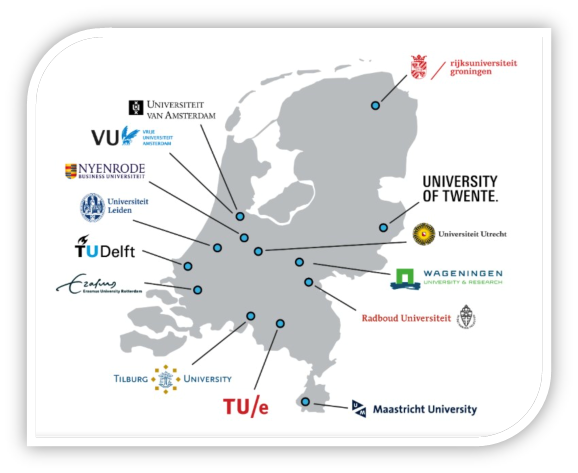
Global Rankings of Dutch Research Universities
- Delft University of Technology 47
- University of Amsterdam 53
- Utrecht University 103
- Leiden University 119
- Eindhoven University of Technology 140
- Erasmus University Rotterdam 140
- University of Groningen 147
- University of Wageningen 153
- Vrije University Amsterdam 194
- Twente University 203
- Maastricht University 239
- Radboud University 279
- Tilburg University 347
Dutch Universities – Program Examples
Engineering
- Technical University of Delft – Aerospace Engineering – (numerus fixus program)
- Eindhoven Technical University – Industrial Engineering
Economics and Management
- Erasmus University Rotterdam – International Business Administration (IBA) (numerus fixus)
- EErasmus University Rotterdam – International Bachelor Economics and Business Economics (IBEB)
- Tilburg University – Economics
Computer Science and Artificial Intelligence
- University of Groningen – Computing Science
- University of Radboud – Computing Science
- Leiden University – Data Science and Artificial Intelligencee
Medicine
- Maastricht University – Medicine (English at bachelor level)
- Groningen University – Medicine (English at bachelor level)
Design
- Rotterdam University of Applied Sciences – Design: Fashion
- ArTEZ- Fashion Design
Pharmaceutical Sciences
- University of Groningen- Pharmacy
Communication and Media
- Erasmus University Rotterdam – Communication and Media
Law
- Tilburg University – Global Law
Dutch Universities – Admission Requirements
The basic requirements for admission to Dutch universities are as follows:
- Completion of a total of 12 years of basic education, including 4 years of high school
- A European Baccalaureate Diploma, International Baccalaureate Diploma, or Turkish MEB diploma accepted as a national diploma usually to be accompanied by at least 4 AP (Advanced Placement) exam scores
- Minimum grade point average determined by each school
- For MEB diploma holders who have not taken AP exams: a 4-year high school diploma and acceptance into a bachelor's degree program offered by an internationally recognized university in Turkey that provides a 4-year bachelor's degree education, and completion of the first year of the program
- An English proficiency certificate obtained with scores from English proficiency exams such as IELTS and TOEFL
In accordance with the specific admission requirements of the programs to which students apply, universities may require various exams.
Application Process
Applications to Dutch universities open on October 1 for programs starting in September of the following year. The application deadlines are generally in April for non-EU citizens and in May for EU citizens. The deadline for numerus fixus programs, which means limited enrollment, is January 15. The final application dates for University Colleges are usually in January, with interviews taking place in February.
The maximum number of applications that can be submitted for the same period is 4. A maximum of 2 of these can be for quota-based programs.
What Preparation is Required?
- GPA (High School Grade Point Average) and Diploma Score – proving the student's academic success in high school
- Standardized Tests (AP, Numerus Fixus Exams, OMPT Exams) – showing that the student is ready for university-level education as required by the program they are applying to
- Language Proficiency (IELTS/TOEFL) – demonstrating that the student has sufficient English language skills to pursue university education in English in the Netherlands
- Letter of Motivation – describing the students’ experiences, lessons learned, thoughts and goals regarding the school they are applying to, and their academic and professional objectives
- CV – demonstrating that the student is active, successful, and focused on their social and academic goals.
Numerus Fixus Programs
Numerus Fixus means “fixed number” in Latin. Some programs have quotas because they are in high demand and popular. Programs such as Computer Science, Psychology, International Business Administration, Medicine, and Physiotherapy fall into this group, although this changes every year.
The Num-fix exams held in February-March are completed on April 15, and a ranking of successful candidates is announced. Some students may be placed on a waiting list. Successful candidates are given 15 days to register for the program; if they do not register, candidates from the waiting list are called. The content of the Num-fix exams varies depending on the university and department.
Conditional Admission
In Dutch admissions, conditional admissions may be granted. These conditions are:
- Conditions based on AP grades – conditions that may be imposed for AP courses taken by the student in 12th grade and completed in July
- Grade point average requirement – the student's 11th and 12th grade grade point average must be at a certain level, or the diploma grade point average must be at a certain level
- Requirement to prove mathematical foundation through exams such as SAT/OMPT
- Requirement to attend a preparatory class for applicants who are not eligible for direct admission
- Requirement to complete the first year of the relevant department in Turkey for applicants who are not eligible for direct admission
- Requirement to succeed in other exams administered by the school
- Requirement to pass the relevant exam and be ranked for quota-based programs
Matching Procedure
Dutch universities apply a procedure called ‘matching’ to allow students who have been accepted or conditionally accepted to familiarize themselves with the program and test their suitability for it.
Completion of the matching procedure, which is non-selective and does not affect admission status, is mandatory.
Some schools conduct the matching process via a questionnaire, while others complete it through webinars held on specific dates followed by tests.
AcceptEd Consultancy Services
AcceptEd supports our students throughout all stages of the process outlined above, including academic performance tracking, school list creation, CV enhancement, motivation letter editing, exam preparation scheduling and follow-up, school selection after decisions, conditional acceptance requirement tracking, student visa procedures, and accommodation support.
We refer students whose academic profile is suitable for Dutch universities and who has the potential to achieve the best results from the opportunities offered by these schools.